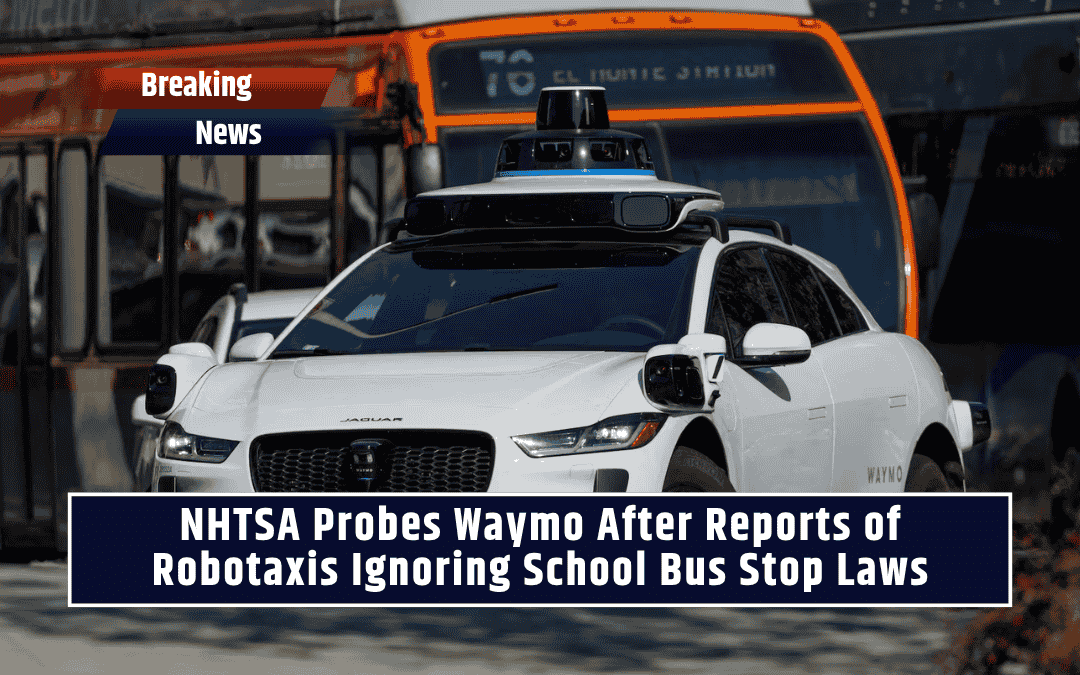
The U.S. National Highway Traffic Safety Administration (NHTSA) has launched a preliminary investigation into Waymo’s fleet of autonomous vehicles after reports that its self-driving taxis may have failed to properly stop for a school bus.
The probe underscores growing federal scrutiny over how autonomous systems interact with pedestrians, cyclists, and other vulnerable road users.
Federal Review Targets Waymo’s Self-Driving Fleet
NHTSA announced Monday that it is investigating approximately 2,000 Waymo vehicles equipped with the company’s fifth-generation Automated Driving System (ADS).
The agency’s Office of Defects Investigation opened the review following reports that a Waymo robotaxi did not remain stationary when approaching a school bus displaying flashing red lights and stop arms — a clear violation of traffic safety law.
Reported Incident Raises Safety Questions
The investigation stems from a media report describing a troubling scenario: a Waymo vehicle initially stopped next to a school bus that was unloading students, then maneuvered around the front of the bus.
The self-driving car allegedly passed the extended stop arm and crossing control arm while children were disembarking, raising alarm about the vehicle’s ability to detect and respond to school bus signals.
Waymo Responds to the Investigation
In response, a Waymo spokesperson said the company has “already developed and implemented improvements related to stopping for school buses” and plans to roll out additional software updates in its next release.
The company emphasized that “driving safely around children has always been one of Waymo’s highest priorities” and that safety updates are an ongoing part of its technology evolution.
Waymo’s Explanation of the Event
According to Waymo, the vehicle involved approached the bus from an angle where the flashing red lights and stop sign were not visible. The company stated that the vehicle proceeded slowly and maintained a safe distance from students.
Still, the explanation highlights the difficulty autonomous systems face when interpreting complex and unpredictable real-world environments, especially those involving children.
No Human Driver Onboard During the Incident
NHTSA confirmed that the Waymo vehicle in question was operating without a human safety driver. This detail adds to the significance of the probe, as the car’s decision-making process relied entirely on its software and sensors.
The incident occurred at a time when regulators are increasingly concerned about the readiness of fully driverless vehicles on public roads.
Expanding Robotaxi Operations Across the U.S.
Waymo, a subsidiary of Alphabet Inc., operates more than 1,500 autonomous vehicles across major cities, including Phoenix, Los Angeles, San Francisco, and Austin.
The company has aggressively expanded its robotaxi services in recent years, promoting them as a safer alternative to human-driven cars. The NHTSA investigation, however, could influence how quickly such deployments continue.
Growing Federal Scrutiny of Self-Driving Systems
This case marks the latest in a series of federal investigations into autonomous vehicle technologies. NHTSA has previously examined incidents involving other companies’ driverless systems, particularly where pedestrians and cyclists were involved.
Regulators are focusing on how self-driving cars handle unpredictable scenarios — from crosswalk interactions to emergency vehicle recognition — that still challenge artificial intelligence systems.
Industry Faces Balancing Act Between Innovation and Safety
The Waymo probe highlights an ongoing tension in the self-driving industry: advancing innovation while ensuring public safety. Companies like Waymo, Cruise, and Tesla have touted autonomy as a pathway to fewer crashes and fatalities, but real-world incidents continue to expose the technology’s limitations.
The federal review may lead to new guidance or regulations for automated driving systems nationwide.
Software Updates and Future Safeguards
Waymo says it has already implemented improvements to its detection and response protocols for school buses. The company also confirmed that additional safeguards will be included in upcoming software releases.
These updates could include enhanced camera recognition, better interpretation of red flashing lights, and improved decision-making logic for handling unusual traffic scenarios.
Broader Implications for the Autonomous Vehicle Market
While the probe targets Waymo specifically, its implications stretch across the entire autonomous vehicle landscape. Regulators are under increasing pressure to establish clearer standards for self-driving technology.
Any findings from the Waymo investigation could set precedents affecting how other companies test, deploy, and monitor driverless fleets in both public and private settings.
Safety at the Forefront
As the investigation unfolds, both NHTSA and Waymo are under scrutiny from safety advocates and lawmakers. For the public, the question remains whether autonomous vehicles can truly make roads safer — especially for children and pedestrians.
The outcome of this probe will not only shape Waymo’s future but could redefine how the U.S. approaches self-driving innovation.